RAMSEY, DOUGLAS KENT
RIP 02/23/18
Name: Douglas Kent Ramsey
Rank/Branch: Civilian
Unit: Foreign Service Officer, U.S. State Department
Date of Birth: ca 1934
Home City of Record: Boulder City NV
Date of Loss: 17 January 1966
Country of Loss: South Vietnam
Loss Coordinates: 110103N 1062628E (XT574182)
Status (in 1973): Released POW
Category:
Aircraft/Vehicle/Ground: Truck
Other Personnel in Incident: (none missing)
Source: Compiled by Homecoming II Project 15 October 1990 from: raw data from
U.S. Government agency sources, published sources including "Civilian POW:
Terror and Torture in South Vietnam" by Norman J. Brookens. Updated by the
P.O.W. NETWORK in 2023.
REMARKS: 730212 RELSD BY PRG
SYNOPSIS: On January 17, 1966, U.S. State Department Foreign Service Officer
Douglas K. Ramsey was driving a truck northwest of Saigon when he was captured
by Viet Cong forces. For Ramsey and for all Americans captured in South
Vietnam, life would be brutally difficult. These men suffered from disease
induced by an unfamiliar and inadequate diet - dysentery, edema, skin fungus
and eczema as well as particularly brutal treatment from guards.
Douglas K. Ramsey was the first to be captured of a group of about 30
Americans who would be held along the Cambodian border. The was the only group
of POWs who were not released from Hanoi in Operation Homecoming in 1973.
In 1967, the Viet Cong captured another prisoner of war -- Army Capt. William
H. Hardy, who was captured on June 29, 1967 as he drove a truck near Saigon.
Around the time of the Tet Offensive in early 1968, the Viet Cong northwest of
Saigon captured still more Americans: State Department employees, Norman
Brookens and Richard Utecht; U.S. civilians Michael Kjome and James Rollins;
Army Cpl. Thomas Van Putten and Australian businessman, Charles K. Hyland.
On April 22, 1968, four POWs who were held together -- Brookens, Utecht,
Hyland and Rollins -- dared an escape. They had secretly learned to remove
their chains, and on this rainy night they made their break. Within seconds of
their freedom, they were soaked. It was impossible to walk in the thick
jungle, so they crawled on hands and knees. They immediately became separated,
and had barely reached the camp border when they were surrounded and
recaptured.
For the next ten days, they were given only several spoons of rice and a pinch
of salt. They were chained and bound with ropes so tight their arms and legs
went completely numb. The ropes were removed after a month, but the chains
remained. The four were rotated between a cage and a pit. Brookens remained in
the pit for several months, lying in his own body waste.
Throughout the spring and summer of 1968, others were captured: Capt. John
Dunn and Pvt. James M. Ray captured on March 18; Pvt. Ferdinand Rodriguez on
April 14; Maj. Raymond Schrump on May 23; SSgt. Felix Neco-Quinones on July
16, SSgt. Bobby Johnson, SP4 Thomas Jones and SSgt. Kenneth Gregory on August
25.
The POWs were kept on the move; some held in groups, and some held alone. It
was a mental challenge to try to keep track of their location, and the POWs
report that they believed they were in Cambodia some of the time, and at other
times near the Ho Chi Minh Trail. During rest periods on the journey they were
held in cages or in deep holes, or chained to trees.
In mid-July, Brookens, Utecht and Rollins were moved to another camp, but
Hyland was left behind. He was released on November 26, 1968. For the first
time, State Department learned that Brookens and Utecht had definitely been
captured.
During 1969 and 1970, the Americans were moved frequently as U.S. air and
artillery strikes came closer. The journeys were pure torture, and the POWs
often lived chained to trees while cages were were built for them. They were
sometimes held in swampy areas thick with snakes and mosquitoes. Some of the
marches occurred during monsoon season, and the prisoners, still wearing leg
chains, walked in neck-deep water. During bomb strikes, some from thundering
B52 and artillery, the men hid in bunkers.
The POWs' health began to reach its limits. They were suffering from
dysentery, beriberi and jungle rot; some had festering wounds from their
captures. In April, 1969, they moved again, living in the jungle until a new
camp was built in Cambodia.
In early April 1969, an American prisoner escaped. Army Cpl. Thomas H. Van
Putten had been captured near Tay Ninh as he operated a road grader on
February 11, 1968. After making his way to friendly forces, Van Putten
identified the POWs held by the Viet Cong in his camp.
In July 1969, a POW committed a minor offense for which the entire camp was
severely punished for 30 days. The prisoner who caused the commotion was later
taken from the camp. Some POWs reported that they last saw the man, who was
only 21 years old, laying on the ground near his cage covered by a piece of
plastic. They believed he was dead and he had died of torture, starvation and
lack of medicine for his ailments. [NOTE: Brookens does not give the name of
this POW who apparently died in July 1969. Although the incident does not
match information found in James M. Ray's personnel file, and Jimmy Ray was
not know to be dead, this account may refer to him.]
In late spring, 1969, the prisoners began to be put together, and they
eventually reached a new camp with above-ground cages, which they believed was
northwest of Tay Ninh near the Cambodian border. Brookens and Utecht were put
in the same cage, and it was the first time Brookens had talked to another
American since the aborted escape attempt two years before.
By June 1969, encroaching artillery forced the POWs westward into Cambodia,
but on July 14, they returned to the border camp where they remained until
December 1970. At this time, they were moved deep into Cambodia. Again they
were chained while cages were built. The POWs remained here until April 1972,
when they were moved to a new, and final camp.
In 1969, 1970, and 1971, more Americans were captured: SP4 Gary Guggenberger
on January 14 1969; U.S. Civilians John Fritz, Jr., James Newingham and Tanos
Kalil on February 8; in 1970: SP4 Frederick Crowson and WO Daniel Maslowski on
May 2; SP4 Keith Albert on May 21; SP4 Richard Springman on May 25; in 1971:
WO James Hestand, captured March 17; American civilian Richard Waldhaus on
August 4.
The POWs were in terrible condition -- painfully thin, with all manner of skin
ailments, dysentery, and malaria. Brookens was so physically depleted that he
could barely walk without the aid of walking sticks.
In 1972, more POWs arrived: MSgt. Kenneth Wallingford, Maj. Albert Carlson and
Capt. Mark A. Smith, captured April 7; Capt. George Wanat, Jr. and Capt.
Johnnie Ray, captured April 8; Air Force Capt. David Baker, captured June 27;
and Marine Capt. James Walsh, Jr., captured September 26.
Then on the morning of February 12, 1973, the men were told they were going
home. By this time, there were 27 in all, five of them civilians. The group
was taken to a small airport outside Loc Ninh, and after 11 hours of waiting,
they were finally allowed to board the helicopters and start for home.
Norm Brookens had lost 55 pounds since his capture, and was treated for a
ruptured colon, a heart condition, jungle rot, malaria and beriberi.
Thomas H. Van Putten resides in Michigan and had a leg amputated in September
1990 as a result of complications stemming from injuries during his captivity.
James M. Ray and Tanos E. Kalil remained missing in action and were not
returned in 1973. Kalil's name was on the PRG list as having died in
captivity. Ray's fate is unknown.
~~~~~~~~~~~~~~
Douglas Ransey resided in Nevada.
|
https://1997-2001.state.gov/publications/statemag/statemag_sept99/feature2.html
|
Feature Story:
POW/MIA
Recognition Day
 |
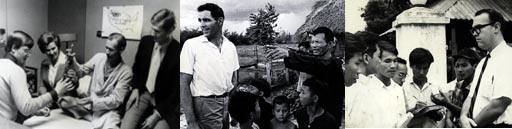
From left, Charles Willis with his wife Josephine and his
sons Howard and Charles at the National Naval Medical Center in Bethesda,
Md., following his release in 1973. Center, Douglas Ramsey in Vietnam before
his capture in 1966. Right J.R. Bullington meets with student demonstrators
in Hue in 1966.
 ept.
17 is National POW/MIA Recognition Day, a day of special tribute to men and
women who, in the service of the United States, became prisoners of war or were
missing in action during wartime. While most of the nation's POWs and MIAs have
been in the military, members of the Foreign Service, too, have suffered the
hardships of enemy captivity with honor, dignity and distinction. Here, taken
largely from their own accounts, are the stories of two Foreign Service officers
held prisoner and one who narrowly escaped capture during the Vietnam War... ept.
17 is National POW/MIA Recognition Day, a day of special tribute to men and
women who, in the service of the United States, became prisoners of war or were
missing in action during wartime. While most of the nation's POWs and MIAs have
been in the military, members of the Foreign Service, too, have suffered the
hardships of enemy captivity with honor, dignity and distinction. Here, taken
largely from their own accounts, are the stories of two Foreign Service officers
held prisoner and one who narrowly escaped capture during the Vietnam War...
|
|
Sent: 2/24/2018 12:56:50 PM Eastern Standard Time
Subject: Doug Ramsey Deceased
Former POW Doug Ramsy moved onward yesterday (Friday) at 4:43pm Pacific Standard
Time (7:43 EST).
I do not yet have any information as to memorial service and internment.
Regards, frank
|
|
CC: in an email from Mike Benge.....
Sad news to pass on. Douglas Ramsey, a friend of many on this list,
died February 23 in Nevada of complications including pneumonia, sepsis,
and organ failure.
Doug joined the U.S. Foreign Service in 1960 and was assigned to Embassy
Saigon in 1963. Early in 1965, he was assigned to AID and the
Provincial Operations program (earlier known as USOM/Rural Affairs). He
served in Hau Nghia Province, first as deputy provrep, then as
provincial representative.
He was captured by the Viet Cong January 17, 1966 while attempting to
deliver medical and other supplies to a needy village. He spent the
next 7 years in the jungles of South Vietnam and Cambodia under
conditions of great physical and psychological hardship. He was
released February 12, 1973 as part of what was known as Operation
Homecoming. Doug attended the 2005 reunion at Westminster.
|
|
RIP Douglas K. Ramsey - CIV |
08/26/18
CC: in an email from Mike Benge....
I regret to inform you that Doug
passed away in Boulder, Colorado on February 23 of this
year. We waited to inform you of his passing until his
interment and a suitable memorial service could be
arranged.
Doug wrote his own obituary. It
barely hints at his many stellar qualities nor his
remarkable life and career. (He was, for example, a
concert-level pianist.) The most challenging episode of his
life, however, was his 7-1/2-year stint as a prisoner of the
Viet Cong in the jungles of Southeast Asia. Doug was
captured early in 1966 in highly-contested Hau Nghia
province while carrying medical supplies to a beleaguered
hamlet. He was one of the last American POWs released.
Several of Doug's colleagues have
planned a memorial service in his honor. It is set for
Friday, October 5, 2018; 3 to 6 p.m. (Arrive early):
DACOR Bacon House
1801 F. Street N.W.
Washington DC
On-street parking is scarce, and a
full house is expected.
...
-
-
To reserve a place inside the main
room, please e-mail: brucekinsey@hotmail.com. Overflow
visitors will be directed to the outdoor patio.
Please make a special effort to honor
this good man.
Kinsey
|