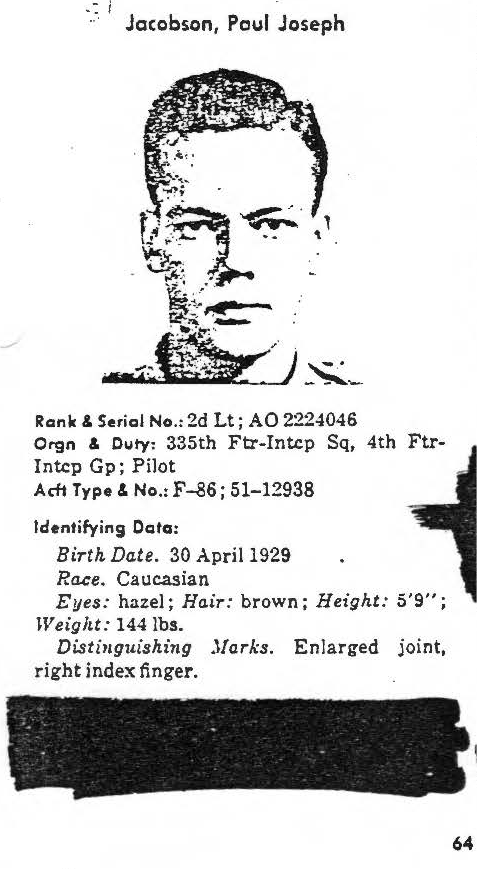
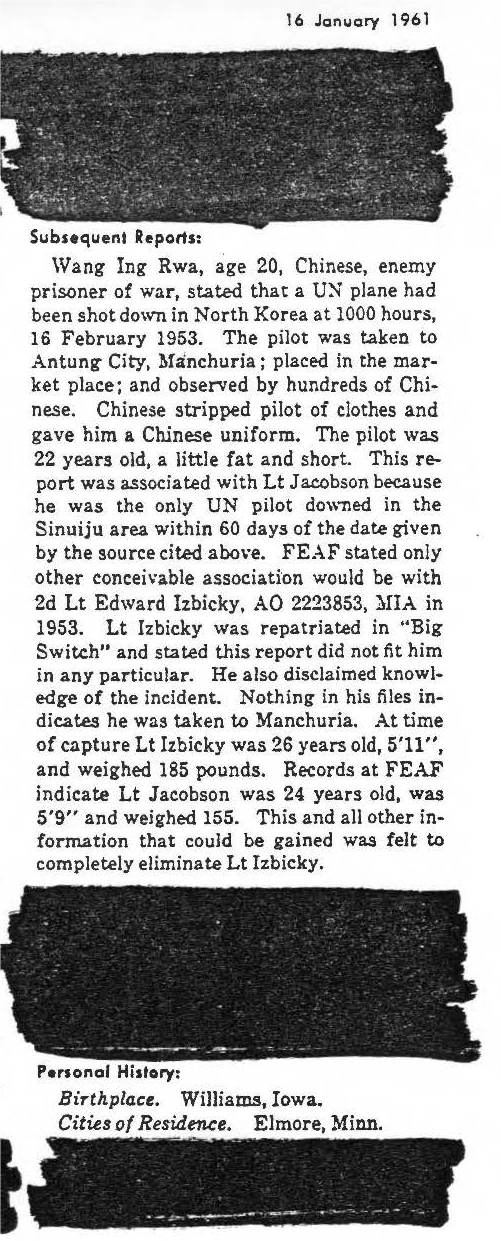
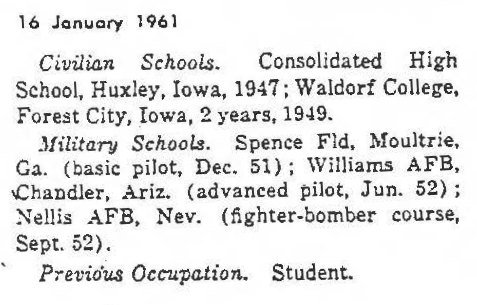
Data Sources - Air Force Manual No. 200-25A, Department of the Air Force, Washington, October 16, 1961 page 1. Sanitized copy. National Archives KOREAN Conflict Casualty File (KCCF) 1950-1954.
_____________________________________________________________________________________
POWs --- MIAs Press Release Immediate
CHINA --- RETURN OUR PRISONERS OF WAR FROM THE VIETNAM WAR AND THE KOREAN WAR
RESOLVE the PRISONER OF WAR ISSUE, from the Korean War and the Vietnam
War!!! This issue remains a priority with the Families and Activists,
who represent the National Alliance of Families for the Return of
AMERICA's Missing Servicemen from World War II, the Korean War, the
Cold War and the Vietnam War.
Our Organization is not against TRADE with CHINA. But the POW ISSUE is
a long overdue obligation for China, to prove that she wants the
friendship of all the American People". stated National Chairperson
Dolores Alfond. "We have families, who have been suffering through
years of NOT knowing, awaiting word of their loved one. I'm sure the
4,000 Chinese families, who lost their loved ones in the Vietnam War
would agree. Let us clear the air, so we may be friends and partners."
............
THE KOREAN WAR:
Lt. Paul Jacobson, a 24 yr. old pilot was attacked by MIG Aircraft in
February, of 1953, over North Korea. He surfaced in Antung, Manchuria. He
was placed in the Market Place, surrounded by hundreds of Chinese. They
stripped him of his uniform and gave him a Chinese uniform. Lt. Jacobson, is
only one of 1,000's held by the Chinese. (documents available)
1951-Early April; 500 American POWs arrived in Hankow where they were
paraded through the streets.
1951-Mid-April; 60 POWs, mostly American with a few British, arrived
in Canton via Railway.
1952-January; 400 U.S. Prisoners (300 of these were Negroes) arrived
in Canton. (document available)
The United States had 1,000's of names, ranks, and locations of our
POWs from the U.S. and Britain. The U.S. had so much evidence regarding our
Boys that the United States planned to have a field of Sea and Air Blockade
of the China Coast which was stated by James J. Kelleher, Office of Special
Operations (CPOW/3 D-1-1955).
In November of 1978; Steve F. Kiba discussed his first hand sightings
of individuals while he was held by the Red Chinese during the Korean War.
Mr. Kiba was discouraged in his effort to discuss his experiences and was
discouraged in his efforts to discuss the sightings by the U.S. Air Force
Intelligence, the CIA and the Department of State. (document available)
The National Alliance of Families would like to encourgae China to
step forward and resolve our concerns by returning our LIVE PRISONERS OF WAR
and any REMAINS they may be holding. We then can discuss the future of our
two countries in Trade and Friendship.
DOCUMENTS: Furnished by Mark Sauter, Investigative Reporter
Contact:
Dolores Apodaca Alfond (206) 881-1499 National Chairperson for the
National Alliance of Families
full file avail through the P.O.W. NETWORK info@pownetwork.org
____________________________________________________________________________
The Transfer of U.S. Korean War POWs
To the Soviet Union
Joint Commission Support Branch
Research and Analysis Division
DPMO
26 August 1993
WORKING PAPER
This study was prepared by
Mr. Peter G. Tsouras, DAC
Major Werner Saemler Hindrichs, USAF
Master Sergeant Danz Blasser, USAF
with the assistance of
Second Lieutenant Timothy R. Lewis, USAF
Mr. Paul H. Vivian, DAC
Staff Sergeant Linda R. H. Pierce, USA
Sergeant Gregory N. Vukin, USA
This Study is for internal use only. It contains subjective evaluations,
opinions, and recommendations concerning on-going analysis that may impact
future U.S. foreign policy decisions. This document has not yet been
finalized for public release.
WORKING PAPER
This study was prepared by
Mr. Peter G. Tsouras, DAC
Major Werner Saemler Hindrichs, USAF
Master Sergeant Danz Blasser, USAF
with the assistance of
Second Lieutenant Timothy R. Lewis, USAF
Mr. Paul H. Vivian, DAC
Staff Sergeant Linda R. H. Pierce, USA
Sergeant Gregory N. Vukin, USA
Executive Summary
U.S. Korean War POWs were transferred to the Soviet Union and never
repatriated.
This transfer was a highly-secret MGB program approved by the inner circle
of the Stalinist dictatorship.
The rationale for taking selected prisoners to the USSR was:
o To exploit and counter U.S. aircraft technologies;
o to use them for general intelligence purposes;
o It is possible that Stalin, given his positive experience with Axis POWs,
viewed U.S. POWs as potentially lucrative hostages.
The range of eyewitness testimony as to the presence of U.S. Korean War POWs
in the GULAG is so broad and convincing that we cannot dismiss it.
The Soviet 64th Fighter Aviation Corps which supported the North Korean and
Chinese forces in the Korean War had an important intelligence collection
mission that included the collection, selection, and interrogation of POWs.
A General Staff-based analytical group was assigned to the Far East Military
District and conducted extensive interrogations of U.S. and other U.N. POWs
in Khabarovsk. This was confirmed by a distinguished retired Soviet
officer, Colonel Gavriil Rorotkov, who participated in this operation. No
prisoners were repatriated who related such an experience.
o Prisoners were moved by various modes of transportation. Large shipments
moved through Manchouli and Pos'yet.
o Khabarovsk was the hub of a major interrogation operation directed
against U.N. POWs from Korea. Khabarovsk was also a temporary holding and
transshipment point for U.S. POWs. The MGB controlled these prisoners, but
the GRU was allowed to interrogate them.
o Irkutsk and Novosirbirsk were transshipment points, but the Komi ASSR and
Perm Oblast were the final destinations of many POWs. Other camps where
Americans were held were in the Bashkir ASSR, the Kemerovo and Archangelsk
Oblasts, and the Komi-Permyatskiy and Taymyskiy Natinal Okrugs.
POW transfers also included thousands of South Koreans, a fact confirmed by
the Soviet general officer, Kan San Kho, who served as the Deputy Chief of
the North Korean MVD.
The most highly-sought-after POWs for exploitation were F-86 pilots and
others knowledgeable of new technologies.
Living U.S. witnesses have testified that captured U.S. pilots were, upon
occasion, taken directly to Soviet-staffed interrogation centers. A former
Chinese officer stated he turned U.S. pilot POWs directly over to the
Soviets as a matter of policy.
Missing F-86 pilots, whose captivity was never acknowledged by the
Communists in Korea, were identified in recent interviews with former Soviet
intelligence officers who served in Korea. Captured F-86 aircraft were taken
to at least three Moscow aircraft design bureaus for exploitaiton. Pilots
accompanied the aircraft to enrich and accelerate the exploitation process.
The Transfer of U.S. Korean War POWs to the Soviet Union
Table of Contents
Introduction 1
Part I: Technological Exploitation 3
The First Modern Air War . . . . 3
The Technology Gap . . . . . . 3
The 64th Fighter Aviation Corps . . . 3
The Soviet Interrogation Effort . . . 4
The Soviet Hunt for F-86 Pilots . . . 5
The 15 F-86 Pilots That Came Home . . . . 8
A Chinese Link in the Chain of Evidence . 11
A Special Air Force Unit . . . . . . . 11
Avraham Shifrin . . . . . . . . . . . . 12
The Soviet Hunt for the F-86 Sabre Jet 12
Sand in the Fuselage . . . . . . . . 13
MGB and GRU: Who Did What? . . . . . 15
Three Case Studies . . . . . . . . . 19
The Case of Cpt Albert Tenney, USAF . . . . 19
The Case of lLt Roland Parks, USAF . . 20
The Case of Cpl Nick A. Flores, USMC 22
Conclusions . . . . . . . 24
Part II: The Hostage Connection . . 26
POW Exploitation . . . . . . . . . . 26
The Stalin - Chou en-lai Meeting 26
Lieutenant General Kan San Kho . . . 27
Colonel Gavril I. Korotkov . . . . . 27
Lieutenant Colonel Philip J. Corso . . . . 31
Lieutenant Colonel Delk Simpson . . . . . . 34
John Foster Dulles . . . 34
Captain Mel Gile . . . . 35
CCRAX 35
Zygmunt Nagorski . . . . 36
Turkish Traveler . . . . . 38
Conclusions . . . . . . . 39
Part III Evidence From Within the Soviet Union . . . 40
Sightings in the Komi ASSR . . 40
Sightings in Khabarovsk . . . 44
Sighting in Irkutsk . . . . . 45
Sighting in Taishet . . . . 46
Sighting in Mordova . . . . . 46
Sighting in Novosibirsk . . . . . 47
Sighting in the Bashkir ASSR . . . 47
Sighting in Norilsk . . . . . . . 47
Sighting in Kemerovo . . . . . . . 48
Sightings in the Kazakh SSR . . 49
Sighting in Archangelsk . . . . . . . 49
Patterns Among the Sightings . . . . 50
Summary 51
Postscript 51
Appendices 53
Appendix A: How Many Men Are Truly Unaccounted For? . . 57
Appendix B: 31 Missing USAF F-86 Pilots Whose Loss
Indicates Possible Capture 68
Appendix C: Korean War USAF F-86 Pilots Who Were 69
Captured and Repatriated
Appendix D: Outstanding Questions 69
Appendix E: Individual Sources of Information
Cited in this Study 74
Appendix F: Soviet Officers Whose Names Appear On
Interrogations of U.S. Korean War POWs 75
Table 1. USAF Korean War POWs On Whom the Russian
Archives Should Have Information . . . . . 7
Table 2. BNR Cases Where Death Was Witnessed by
Repatriates or Otherwise Documented . . . 55
__________
Appendix B
31 Missing USAF F-86 Pilots whose Loss
Indicates Possible Capture
Name Date of Casualty
1. Cpt William D. Crone 18 Jun 51
2. Cpt Robert H. Laier 19 Jun 51
3. lLT Laurence C. Layton 2 Sep 51
4. lLT Carl G. Barnett, Jr. 26 Sep 51
5. Cpt Charles W. Pratt 8 Nov 51
6. lLT Charles D. Hogue 13 Dec 51
7. lLT Lester F. Page 6 Jan 52
8. lLT Thiel M. Reeves 11 Jan 52
9. lLT Charles W. Rhinehart 29 Jan 52
10. lLT Thomas C. Lafferty 31 Jan 52
11. CPT Charles R. Spath 3 Feb 52
12. CPT Jack C. Langston 10 Mar 52
13. lLT James D. Carey 24 Mar 52
14. Maj George V. Wendling 13 Apr 52
15. CPT Albert G. Tenney 3 May 52
16. CPT John F. Lane 20 May 52
17. Maj Felix Asla, Jr. 1 Aug 52
18. Maj Deltis H. Fincher 22 Aug 52
19. Cpt Troy G. Cope 16 Sep 52
20. 2LT Jack H. Turberville 18 Nov 52
21. lLT Donald R. Reitsma 22 Dec 52
22. 2LT Bill J. Stauffer 26 Jan 53
23. lLT Paul J. Jacobson 12 Feb 53
24. lLT Richard M. Cowden 9 Mar 53
25. lLT Robert R. Neimann 12 Apr 53
26. Cpt Frank E. Miller, Jr. 27 May 53
27. lLT John E. Southerland 6 Jun 53
28. lLT Allan K. Rudolph 19 Jun 53
29. Cpt Charles E. Gunther 19 Jun 53
30. lLT Jimmy L. Escale 19 Jun 53
31. 2LT Gerald W. Knott 20 Jul 53
Source: USAF Casualty Affairs...
23. Pilot: 1st Lieutanant Paul J. Jacobson, USAFR
Date of Casualty: 12 February 1953
Status: MIA
Over the town of Sinuiju, Lieutenant Jacobson's flight
encountered and engaged in battle six enemy aircraft.
Lieutenant Jacobson was last seen at an altitude of
approximately 36,000 feet and was apparently experiencing no
difficulty at the time. Following the battle, he failed to
rejoin the flight and air search of the area failed to reveal
any trace of him. An intelligence report from an interrogation
of a captured Chinese soldier revealed that at 1000 hours on 16
February 1953, a UN pilot was shot down over the Sinuiju, North
Korea. The pilot was captured and taken to Antung where he was
placed on exhibition in the marketplace and labeled a "crook of
the air" by a Communist officer. A brief description of the
pilot was given and to a degree the information appears to
conform to the official data of record concerning Lieutenant
Jacobson. Although the date of 16 February is at variance with
the date his F-86 was lost, it has been established that no
other UN plane became missing in the Sinuiju area during the
period in question....
The lists, the printed minutes of the May 27, 1957 hearing and the
"sense of congress" resolution were subsequently buried in the
archives. The original list had 450 names compiled from American POWS who were
repatriated by the Reds, as well as from photographs released by the Reds, Chinese
radio propaganda broadcasts, and letters written home by captured men. The "revised" list was narrowed down in august of 1961 to 389 men, and
all were arbitrarily declared dead by the military services, the USG still
lists them as "unaccounted for".
Names and ranks only were released at the time, and printed in "The
Spotlight" on August 27, 1979, along with the above information and background.
Further information has been compiled by the P.O.W. Network from the Hawaii POW/MIA
Korean Memorial records, National Archives documentation, and public United
States Air Force documentation, and changes made to the original published
information. (FEBRUARY 1992)
Paul Jacobsen is listed on the "HONOR ROLL OF FORGOTTEN AMERICANS" yet is noted as having died "while missing" by the National Archive.
03/12/2021
- KOREAN WAR
- UNITED STATES AIR FORCE
- Unaccounted For
First Lieutenant Paul Joseph Jacobson, who entered the U.S. Air Force from Minnesota, served with the 335th Fighter-Interceptor Squadron, 4th Fighter-Interceptor Group. On February 12, 1953, he took off from K-14 Kimpo airbase, South Korea, he was the pilot of an F-86 Sabre (serial number 51-12938) on a combat escort mission for an RF-80 reconnaissance aircraft over North Korea. As the RF-80 made its pass over the town of Sinuiju, enemy MiG fighters approached and aerial combat ensued. During the engagement, other friendly pilots lost visual contact with 1st Lt Jacobson's aircraft. Afterward, he did not rejoin the flight and the other pilots could not establish radio or visual contact with him. They searched the area but saw no sign of a crash site, wreckage, a parachute, or any other indication of 1st Lt Jacobson's fate. No returning POWs mentioned having contact with 1st Lt Jacobson, nor was he seen at any known holding point, interrogation center, hospital, or permanent POW camp. He has not been associated with any remains returned to U.S. custody after the ceasefire, and he is still unaccounted-for. Today, First Lieutenant Jacobson is memorialized on the Courts of the Missing at the National Memorial Cemetery of the Pacific.
Based on all information available, DPAA assessed the individual's case to be in the analytical category of Deferred.
If you are a family member of this serviceman, DPAA can provide you with additional information and analysis of your case. Please contact your casualty office representative.
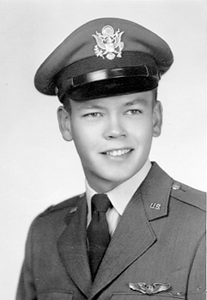 1st Lt PAUL JOSEPH JACOBSON
|